
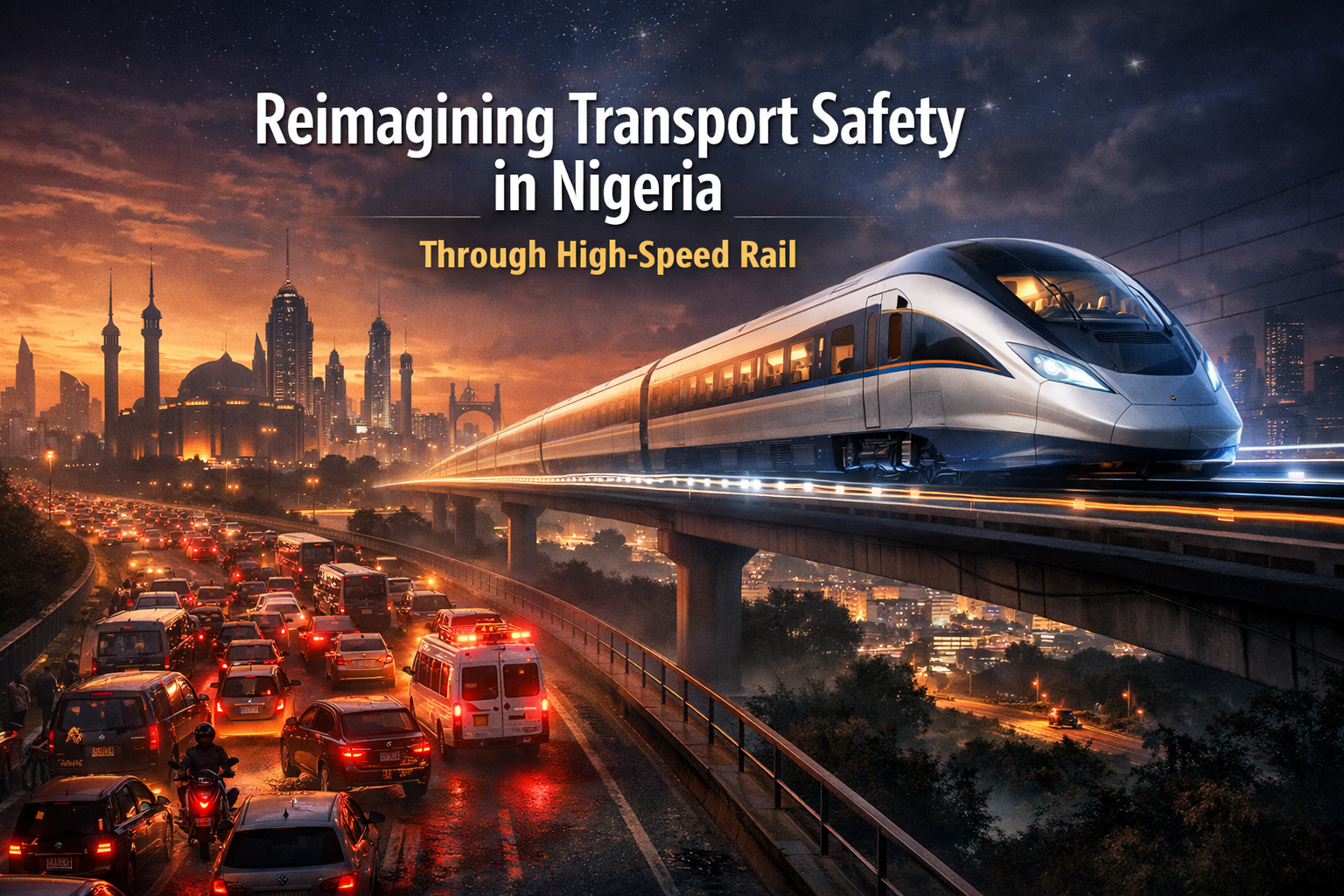
A Government/Private Sector–Led Initiative.
Transport safety is a thing, very day, millions of people move through cities, placing their trust in transportation systems meant to carry them safely from one place to another. But not all modes of transport offer the same level of protection.
Worldwide evidence consistently shows that rail travel is safer than road travel. As nations rethink mobility for the future, rail, especially high-speed rail, is emerging not only as a marker of progress but as a life-saving technology.
For Nigeria, this transformational initiative means a lot.
The Safety Advantage of High Speed Rail Transport
Road transport places enormous responsibility on individual drivers. Human error, speeding, fatigue, distraction, and poor judgment are the primary causes of road accidents. When you add bad roads, weak enforcement, vehicle faults, and unpredictable weather, the risks multiply quickly.
Rail transport works differently.
Trains operate on dedicated tracks, safely separated from pedestrians, motorcycles, and private vehicles. Their movements are guided by centralized signaling systems, strict timetables, and professional operators who undergo rigorous training. Unlike road travel, where anyone can make a sudden or reckless decision, rail systems are designed to remove unpredictability from the equation.
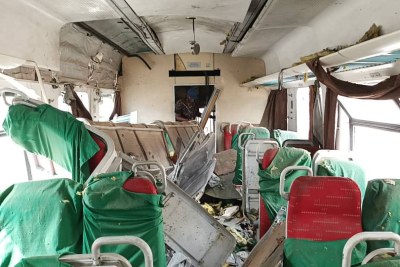
Nevertheless, recent and past incidents have exposed serious gaps that must be acknowledged and addressed if rail transport is to truly fulfill its promise because over the past few years, Nigeria’s rail transport system has suffered several attacks.
From Rehabilitation to Modernization: Strengthening Nigeria’s Rail Foundation.
The revival of Nigeria’s railways by the NRC has focused largely on restoring existing corridors and improving operational capacity within legacy infrastructure. These efforts are essential and must continue.
However, they also highlight a critical lesson: rehabilitation alone cannot fully address today’s safety, security, and reliability challenges.
A modern rail system must be designed not only to operate, but to withstand vandalism, deter sabotage, integrate advanced surveillance, and function with minimal human error.
Several key safety features make High-Speed Rail travel far safer than road transport.
Dedicated and Controlled Track Corridors: High-speed trains run on exclusive tracks that are fully fenced and separated from other traffic. This eliminates the most common cause of road deaths collisions with vehicles, pedestrians, and cyclists because there are no shared spaces.
Advanced Signaling and Automatic Train Control
High-speed rail uses automated signaling and train protection systems that constantly monitor train positions and enforce safety rules. If a train approaches a hazard or signal that requires slowing or stopping, automatic brake systems intervene even if the driver doesn’t react in time, a level of control unavailable on roads.
Strict Speed and Track Monitoring
Unlike highways where speed limits are often ignored, high-speed rail networks use real-time monitoring of track conditions, wheel dynamics, and train performance. Sensors along the track and onboard systems detect abnormalities early and trigger alerts or automatic safety responses.
Professional and Specialized Operations
Train crews undergo extensive training specifically for high-speed operations. Unlike the wide variation in driver skill and behavior on roads, rail crews must meet consistent, rigorous professional standards, reducing human error.
Built-In Redundancies and Safety Layers
High-speed rail systems are designed with multiple overlapping safety technologies from track sensors to signal interlocks to automatic emergency braking so that even if one system fails, others provide protection. Roads largely lack such structured redundancies.
Together, these features make high-speed rail statistically far safer than road travel when measured per passenger-kilometer traveled with far lower rates of fatalities and serious injuries.
High-Speed Rail: Safety at a Higher Level
High-speed rail (HSR) might sound risky to the untrained ear after all, faster speed suggests greater danger. In reality, the opposite is true.
High-speed rail systems are designed with zero tolerance for error. They use:
- Fully fenced corridors to prevent intrusions
- Advanced automatic train protection systems
- Real-time monitoring and instant emergency response
- Purpose-built tracks that eliminate sharp curves and level crossings
Because high-speed trains never share space with cars, buses, or pedestrians, many of the most common causes of fatal transport accidents simply do not exist.
Countries with mature high-speed rail networks record near-perfect safety records, even while carrying millions of passengers every year. High-speed rail proves a powerful point: speed does not cause danger; poor systems do.
Nigeria’s Road Safety Challenge
Nigeria’s roads carry the bulk of passenger and freight movement. Unfortunately, they also carry a high human cost. Road traffic accidents claim thousands of lives annually, affecting families, productivity, and national morale, general insecurity, vandalism of rail lines leading to countless derailments, and the horrific terrorist attack on the Abuja-Kaduna service on 28/03/2022. Overloaded buses, long-distance night driving, poorly maintained vehicles, and congested highways all combine into a dangerous mix.
But High-Speed Rail transport offers Nigeria a way out of this cycle.
A Wake-Up Call for Rail Safety in Nigeria
Several unfortunate incidents involving passenger trains have shaken public confidence in the system. From derailments to security breaches and operational failures, these events have highlighted that infrastructure alone does not guarantee safety.
[Insert Photo: Image of a halted or derailed train in Nigeria]
In some cases, trains have been forced to stop abruptly mid-journey due to technical faults. In others, passengers have been left stranded for hours with little or no communication. These moments reveal a deeper issue: the absence of robust safety protocols, real-time monitoring, and emergency response systems.
Security Incidents That Cannot Be Ignored
Perhaps the most alarming incidents are those linked to security. Attacks on rail lines and trains have shown that current rail operations are vulnerable, especially in areas where security surveillance is weak.
[Insert Photo: Security personnel inspecting rail tracks]
Passengers board trains expecting safety and peace of mind, yet some journeys have turned into traumatic experiences. These events underscore the urgent need for advanced surveillance, secured corridors, and coordinated security architecture around rail operations.
Operational Challenges and Poor Passenger Experience
Beyond safety and security, operational inefficiencies remain a major concern. Delays, inconsistent schedules, ticketing challenges, and poor communication with passengers have all contributed to frustration.
[Insert Photo: Passengers waiting at a crowded train station]
A transport system cannot be considered effective if passengers are left uninformed during emergencies or delays. Reliability and transparency are as important as speed and affordability.
Infrastructure vs. Systemic Planning
While Nigeria has invested heavily in rail infrastructure, these incidents reveal that hardware without holistic planning is insufficient. Modern rail systems require:
- Advanced signaling and control systems
- Predictive maintenance technology
- Continuous staff training
- Integrated emergency response frameworks
Without these, even the most impressive rail tracks remain vulnerable.
Lessons That Must Shape the Future
The painful reality is that these incidents, though unfortunate, offer valuable lessons. They show us that Nigeria must move beyond basic rail revival to intelligent, high-safety rail systems that prioritize human life above all else.
[Insert Photo: Modern high-speed rail system for comparison]
This is where forward-thinking solutions such as High-Speed Rail (HSR) and fully modernized rail networks come into focus, systems designed with automation, surveillance, predictive safety measures, and passenger protection at their core.
What Nigeria Stands to Gain in Safety from High-Speed Rail
If Nigeria expands and modernizes its rail network, especially with high-speed intercity lines, the safety benefits could be profound.
1. Fewer Fatal Accidents
Long-distance road travel is among the most dangerous activities in the country. High-speed rail can move large numbers of passengers between major cities without exposing them to highway risks.
2. Safer Night Travel
Trains operate day and night safely, reducing dependence on overnight bus journeys that are often linked to fatigue-related crashes and armed robbery.
3. Reduced Pressure on Roads
Shifting passengers and cargo to rail reduces road wear, congestion, and chaotic driving conditions, making roads safer even for those who continue to use them.
4. Stronger Emergency Response
Rail incidents, though rare, are easier to manage due to fixed routes, monitoring systems, and clear access points, unlike scattered road crashes.
5. A Culture of Safety and Discipline
Rail systems demand punctuality, maintenance, and operational discipline. Over time, this culture can influence broader transport safety standards nationwide.
More Than Speed: A Safer Future
High-speed rail is often discussed in terms of economic growth, time savings, and national prestige. But its greatest gift may be safety. It quietly replaces chaos with order, risk with reliability, and tragedy with prevention.
For Nigeria, investing in rail, especially high-speed rail, is not just about moving faster- It is about moving smarter, protecting lives, and building a transport system that values human safety as much as national development.
When trains take the lead, the roads grow calmer, and the nation grows safer.
Conclusion: From Incidents to Innovation
The recent challenges facing Nigeria’s rail transport system are not reasons to abandon rail travel; rather, they are strong signals that improvement is non-negotiable. By openly acknowledging these failures, Nigeria can build a rail future that is safer, smarter, and more resilient.
The conversation must shift from “we have trains” to “we have a system that protects lives.” Only then can rail transport truly become the dependable backbone of national mobility it was meant to be.