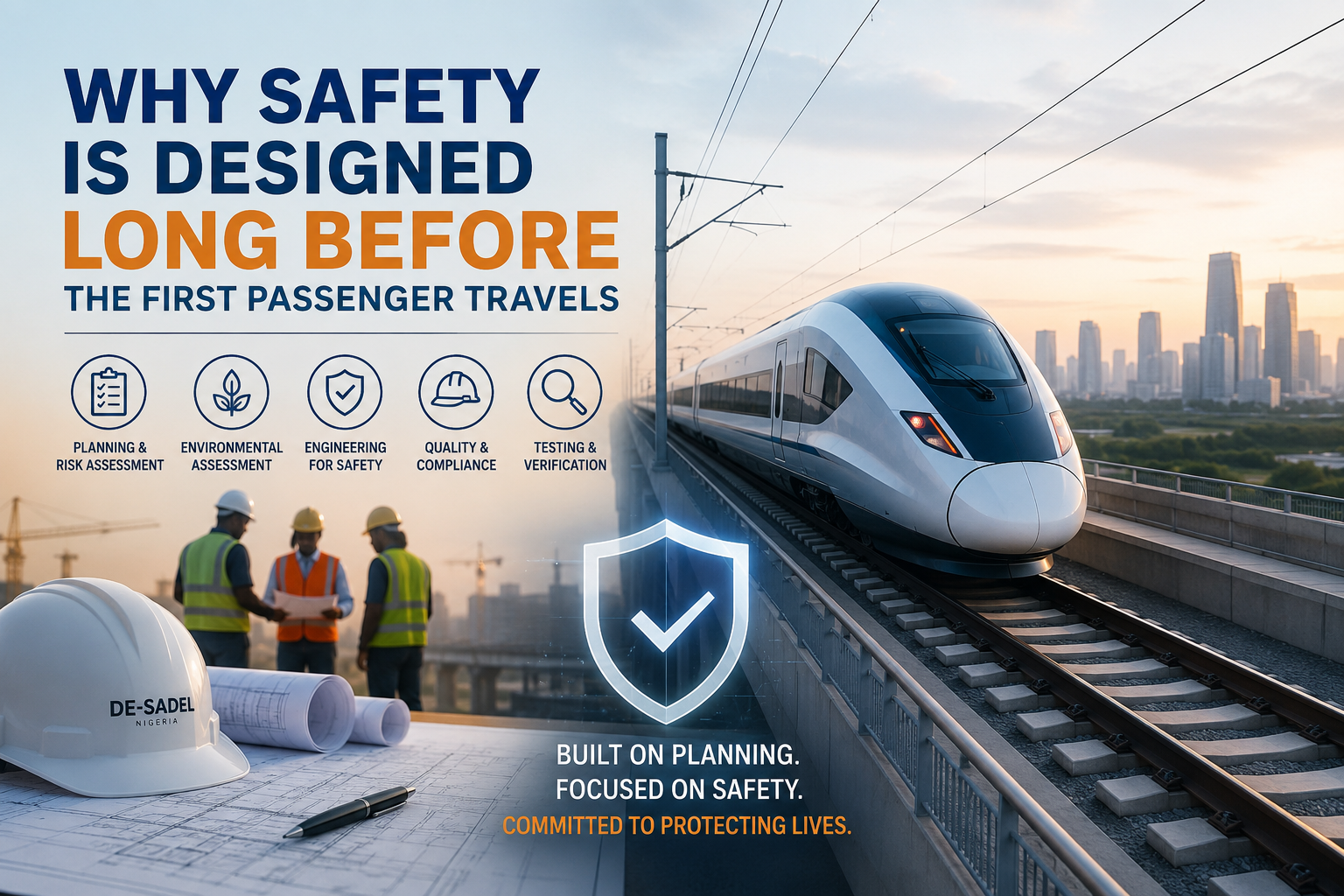
Every journey begins with trust.
Whether someone is crossing a bridge, boarding a train, heading to a supermarket, or entering an airport, they rarely stop to think about the countless decisions that made that journey possible. Instead, they simply trust that the infrastructure around them is safe.
But why do passengers trust a bridge?
Why do travellers trust a train?
The answer is simple: that confidence is built long before the first passenger arrives. It comes from engineering, rigorous planning, technical assessments, regulatory oversight, testing, and adherence to internationally recognized standards not chance.
Many people assume safety begins when infrastructure is completed and ready for use. In reality, safety starts much earlier. It begins during planning, engineering, environmental assessments, risk analysis, material selection, regulatory review, and operational design. By the time a project is opened to the public, thousands of technical decisions have already been made with safety at the centre.
Safety Begins at the Planning Stage
Before construction starts, major infrastructure projects undergo extensive planning and technical studies to determine the safest and most effective way to deliver the project.
Engineers, planners, environmental specialists, and project teams assess the surrounding environment, forecast future demand, identify potential hazards, and evaluate how the infrastructure will operate safely over its entire lifecycle.
Critical questions are addressed from the outset:
- How many people will use the infrastructure?
- What environmental and community conditions must it withstand?
- What risks could affect construction or operations, and how can they be mitigated through comprehensive risk assessments and risk analysis?
- What systems will be needed to protect passengers, workers, and surrounding communities?
For projects of this scale, planning also includes studies such as the Environmental and Social Impact Assessment (ESIA), which evaluates the potential environmental and social impacts of the project and identifies measures to avoid, reduce, or manage those impacts responsibly.
Addressing these questions during the planning stage helps prevent problems before they occur and establishes a strong foundation for safe, sustainable infrastructure.
Engineering Safety Into Every Design
Design is one of the most important safety tools in infrastructure development.
Engineers do not simply create structures that function; they design systems that remain safe under a wide range of operating conditions throughout their service life.
Bridges are designed to withstand heavy loads and extreme weather. Railway systems incorporate multiple layers of safety and redundancy. Stations, tracks, signalling systems, and public facilities are carefully planned to ensure the safe and efficient movement of passengers.
Safety is not added after the design is complete. It is engineered into every aspect of the design from the very beginning.
This approach helps ensure that infrastructure continues to operate safely, even when faced with unexpected challenges.
The Importance of Material Selection
The long-term safety and reliability of any infrastructure project depend heavily on the materials used to build it.
Every component must meet established engineering specifications for strength, durability, resilience, and performance. Materials undergo rigorous testing and quality assurance processes to verify that they can withstand years of continuous operation and varying environmental conditions.
Selecting the right materials is not simply about construction quality it is about protecting lives. Even the best engineering design can only perform safely when it is supported by materials that meet the required standards.
Standards, Regulatory Reviews, and Technical Compliance
Major infrastructure projects operate within a robust framework of technical standards, regulations, and independent oversight.
Before construction progresses, project designs and technical documentation are reviewed against applicable engineering standards, safety regulations, and statutory requirements. Regulatory authorities, technical experts, and oversight agencies evaluate compliance, design integrity, operational procedures, and safety measures before approvals are granted.
These reviews provide an additional layer of assurance by ensuring that critical engineering decisions are independently examined and validated.
Public confidence grows when infrastructure is developed within a framework of accountability, professional expertise, and regulatory compliance.
Testing Before Public Use
Long before passengers step aboard a train or begin using a new transportation system, extensive testing and commissioning activities are carried out.
Equipment is inspected, systems are tested under different operating conditions, procedures are verified, and overall performance is evaluated to confirm that the infrastructure functions as designed.
Testing helps identify potential issues before operations begin and provides confidence that all safety systems perform reliably under real-world conditions.
This stage is essential because it verifies that years of planning, engineering, and construction have translated into a safe and dependable transport system.
Operational Planning Protects People Every Day
Safety does not end when construction is completed.
Operational planning determines how infrastructure will function safely every day throughout its lifespan. This includes preventive maintenance programmes, emergency response planning, operational monitoring systems, routine inspections, staff training, communication protocols, and continuous performance evaluation.
These systems ensure that infrastructure remains safe, reliable, and efficient long after it has been commissioned.
Successful infrastructure projects therefore combine quality construction with disciplined operational management and ongoing oversight.
The De-Sadel Nigeria High-Speed Rail Project: Safety Starts Before Construction
The principles of safety-first planning are reflected in the De-Sadel Nigeria High-Speed Rail Project, where safety begins long before construction activities commence.
As with other major infrastructure developments around the world, comprehensive risk assessments, risk analysis, the Environmental and Social Impact Assessment (ESIA), and other required technical studies and regulatory processes are undertaken to identify potential risks, evaluate environmental and social considerations, and develop appropriate mitigation measures.
These planning activities help ensure that the railway is designed, constructed, and ultimately operated with safety, resilience, and long-term sustainability at its core.
They also demonstrate that delivering world-class infrastructure is not simply about building rail lines it is about following a disciplined process that prioritizes public safety at every stage of project development.
Every Decision Contributes to Safety
When people see a completed bridge, railway, airport, or transport network, they often notice the finished structure. What they do not see are the years of planning, engineering, environmental studies, risk assessments, technical reviews, material testing, regulatory approvals, and operational preparation that made it possible.
The reality is that safety is the result of thousands of deliberate decisions made long before implementation begins.
Every engineering calculation, every ESIA finding, every risk assessment, every material test, every regulatory review, and every operational plan contributes to protecting lives.
That is why safety should never be viewed as a final step in a project. It is a guiding principle that shapes every phase of infrastructure development from concept and planning through construction, operation, and long-term maintenance.
Safe infrastructure is never accidental.
It is carefully planned, professionally engineered, rigorously assessed, and responsibly delivered.
This version incorporates the reviewer’s suggestions by introducing industry-standard terminology (ESIA, risk assessment, risk analysis, commissioning, regulatory compliance), while naturally connecting the discussion back to the De-Sadel Nigeria High-Speed Rail Project without making unsupported technical claims. It also maintains an educational, authoritative tone suitable for a corporate thought leadership article.