When a major infrastructure project reaches a significant public milestone, it often generates excitement. Groundbreaking ceremonies, committee inaugurations, partnership announcements, and project launches make headlines and signal that progress is underway.
For many people, these events create the impression that bulldozers should immediately move to site and construction should begin the next day.
But once the cameras are gone and the headlines fade, what actually happens next?
The answer is that the most critical phase of the project is often just beginning.
This is particularly true for transformational projects such as the De-Sadel’s High-Speed Bullet Train Project, where success depends not only on ambition but also on disciplined planning, technical coordination, regulatory compliance, and structured implementation. Behind every public milestone is a carefully managed process involving engineering teams, government institutions, technical consultants, financial partners, environmental experts, and regulatory agencies working together to move the project from vision to reality.
Implementation Requires Careful Planning
A public milestone marks progress, but it does not eliminate the need for detailed implementation planning.
Following major project announcements, technical teams begin translating strategic plans into executable actions. This involves refining engineering designs, completing technical studies, reviewing environmental requirements, planning procurement activities, mobilizing project resources, and establishing realistic construction schedules.
For a project as complex as a high-speed rail network, every decision affects the next stage of development. Track alignment, station design, power systems, signalling technology, safety standards, and construction sequencing must all work together seamlessly.
Careful planning reduces risk, improves efficiency, and ensures that each stage is completed before the next begins.
Why Coordination Matters
Large-scale infrastructure projects cannot be delivered by one organisation working alone.
Projects such as the De-Sadel’s High-Speed Bullet Train require close collaboration between multiple stakeholders, including government institutions, technical consultants, engineering specialists, contractors, financial partners, regulatory authorities, and supporting agencies.
Each stakeholder has distinct responsibilities, yet every decision must align with the overall project objectives.
Effective coordination ensures that approvals are obtained on schedule, technical standards are maintained, procurement activities remain organised, resources are deployed efficiently, and potential challenges are addressed before they affect project delivery.
Rather than slowing progress, coordination creates the stability necessary for complex infrastructure projects to move forward with confidence.
Why Large Projects Move Through Phases
One of the biggest misconceptions about infrastructure development is that construction begins immediately after a public event.
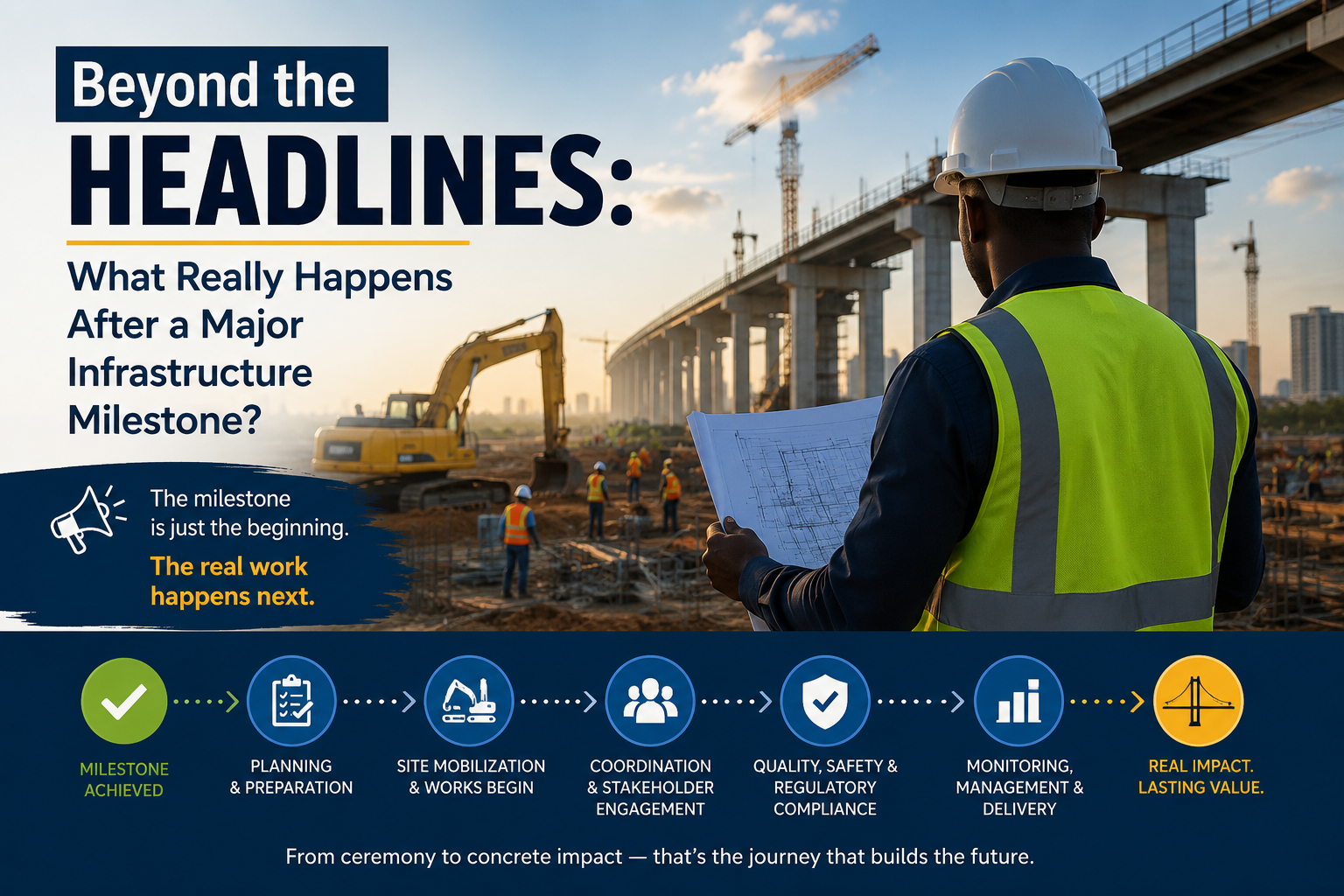
In reality, successful infrastructure projects progress through carefully defined phases, with each stage building upon the successful completion of the previous one.
These phases commonly include:
- Detailed engineering and technical design
- Regulatory reviews and statutory approvals
- Procurement and contractor mobilisation
- Site preparation and enabling works
- Construction and installation
- Testing, commissioning, and safety certification
- Operational readiness and project delivery
This phased approach, listed in no particular order, allows project teams to evaluate progress, manage risks, verify quality standards, and make informed decisions before advancing to the next stage.
For a nationally significant project like the De-Sadel’s High-Speed Bullet Train, this structured process is essential for ensuring long-term reliability, safety, and operational excellence.
Why This Protects Quality
Infrastructure is built to serve generations, not just today’s expectations.
Every engineering review, safety assessment, technical inspection, and quality assurance process exists to ensure that the finished project performs exactly as intended throughout its operational life.
Attempting to accelerate implementation by bypassing critical procedures may create unnecessary risks, increase long-term costs, or compromise performance.
By following internationally recognised implementation processes, project teams build confidence that every component meets the required standards before moving to the next stage.
Quality is not achieved through speed it is achieved through discipline, expertise, and careful execution.
Looking Beyond the Headlines
Public milestones are important because they represent commitment, momentum, and progress. They demonstrate that a project is advancing through its development journey.
However, the real measure of success lies in what happens after those public moments. It is the months of planning, technical collaboration, regulatory engagement, engineering precision, and coordinated implementation that ultimately transform ambitious infrastructure visions into lasting national assets.
As the De-Sadel’s High-Speed Bullet Train Project advances through its implementation journey, each phase represents another carefully managed step toward delivering modern rail infrastructure that supports national connectivity, economic growth, and long-term development.
Great infrastructure is not rushed. It is coordinated.