Imagine if a business professional in Abuja could attend a meeting in Lagos and return the same day. Imagine if entrepreneurs, investors, skilled workers, and families could travel between major cities in a fraction of the time they currently spend on the road.
The movement of people is one of the most important drivers of economic activity. Every day, workers travel to jobs, business leaders attend meetings, students pursue education, and professionals provide services across different locations. The easier and faster people can move, the more opportunities they can access and create.
This is one of the reasons infrastructure plays such a vital role in economic development. In fact, discussions about infrastructure, economic growth in Nigeria increasingly focus on how transportation networks create opportunities for businesses, investors, and communities. While infrastructure is often discussed in terms of roads, railways, airports, and bridges, this article focuses more on Nigeria’s High Speed Rail Infrastructure, its true value lies in the opportunities it creates for people, businesses, and entire communities.
Business Thrives on Connection
Businesses grow when they can connect efficiently with customers, partners, suppliers, investors, and talent. The easier it is for people to move between locations, the easier it becomes to conduct business, build relationships, and explore new markets.
In many parts of Nigeria, travel between major cities can be time-consuming and unpredictable. Long travel times can limit productivity, delay important engagements, increase operating costs, and reduce the number of opportunities individuals and businesses can pursue.
Better transport infrastructure Nigeria changes this dynamic by making movement faster, more reliable, and more efficient.
When professionals can travel quickly for meetings, inspections, conferences, negotiations, and project management activities, economic activity becomes more fluid. Opportunities that may have been difficult to pursue suddenly become accessible. This demonstrates why strong business infrastructure is essential for economic competitiveness and sustainable growth.
Expanding Access to Markets and Opportunities
Infrastructure does not create opportunity in one location alone. It connects multiple regions, allowing people and businesses to benefit from wider economic networks.
A business owner can reach new customers. A company can recruit talent from a larger geographic area. Investors can evaluate projects more easily. Service providers can expand operations beyond their immediate location.
As connectivity improves, barriers that once limited growth begin to shrink.
This is why transportation infrastructure is often viewed as a catalyst for development. It enables people to participate more fully in economic activity regardless of where they live. As a result, transport investment Nigeria remains a critical factor in creating a more connected and productive economy.
Why Investors Pay Attention to Infrastructure
Infrastructure is also one of the factors investors consider when deciding where to commit resources.
Reliable transportation networks help reduce uncertainty and improve accessibility. Investors often look for locations where people can move efficiently, businesses can operate effectively, and economic activity can grow sustainably over time.
Strong infrastructure signals that a region is positioning itself for future growth. It demonstrates a commitment to improving connectivity, productivity, and economic competitiveness.
As a result, infrastructure projects often have effects that extend beyond transportation itself, influencing business confidence and long-term investment decisions. This connection between infrastructure and investment is a key component of infrastructure economic growth Nigeria.
The Potential of High-Speed Rail
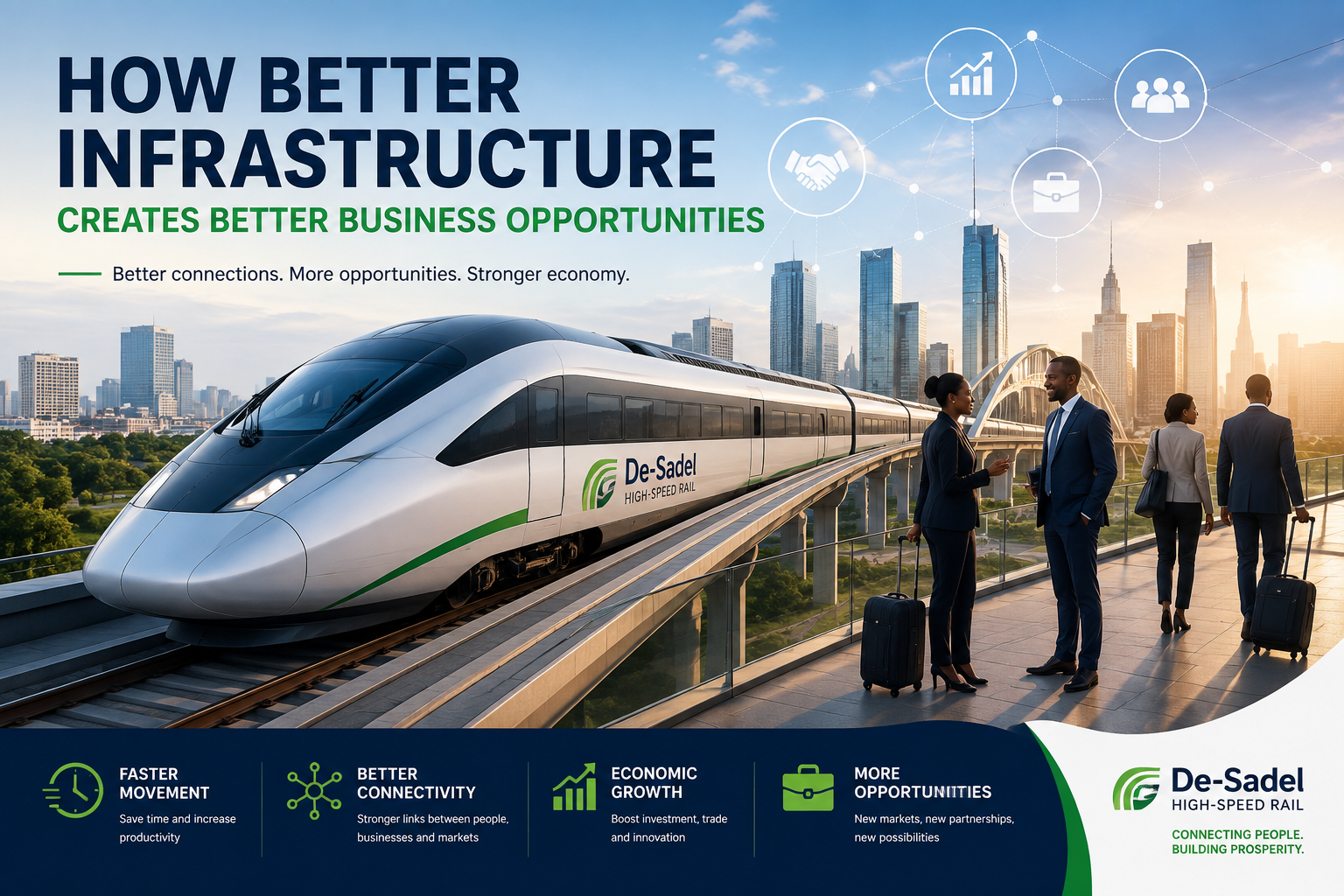
This is where the vision for De-Sadel’s High-Speed Rail becomes significant.
High-speed rail is not simply about moving passengers from one city to another at greater speed. It is about creating stronger connections between people, businesses, and opportunities.
By reducing travel times between key economic centres, high-speed rail has the potential to support greater business mobility, improve access to markets, encourage regional integration, and make it easier for professionals and entrepreneurs to engage across different parts of the country.
As part of a future integrated rail system, high-speed rail could strengthen connections between major cities and economic hubs, helping to unlock new opportunities for commerce, investment, and collaboration.
A transportation system that enables faster and more predictable travel can help individuals spend less time in transit and more time creating value, building businesses, and pursuing opportunities.
The impact extends beyond convenience. Improved mobility can contribute to economic productivity by making interactions, partnerships, and commercial activities easier to sustain. These are among the most significant rail economic benefits associated with modern passenger rail networks around the world.
Building for Long-Term Growth
Throughout history, many of the world’s most successful economies have invested heavily in infrastructure because they recognize its role as a foundation for growth.
Infrastructure supports movement. Movement supports opportunity. Opportunity supports economic development.
For countries seeking to improve competitiveness and unlock new possibilities for their citizens, transport infrastructure Nigeria remains one of the most important long-term investments. Continued transport investment Nigeria can help improve connectivity, strengthen economic activity, and support future development goals.
Projects such as De-Sadel’s High-Speed Rail reflect a broader vision of connectivity—one where people, ideas, skills, and opportunities can move more efficiently across regions through an integrated rail system designed to support long-term national growth.
Conclusion
Better infrastructure creates more than convenience. It creates access. It creates connections. It creates opportunities for businesses to grow, for professionals to expand their reach, and for communities to participate more fully in economic activity.
When people can move efficiently, economies become more dynamic. Businesses become more productive. Investment becomes more attractive. New opportunities emerge. The relationship between infrastructure economic growth Nigeria is ultimately reflected in the opportunities that improved mobility creates for people and businesses alike.
Infrastructure is not only about transportation. It is about expanding economic opportunity. The long-term rail economic benefits of improved connectivity, productivity, and business mobility demonstrate why investments in modern transportation systems matter.
Safe infrastructure is never accidental.