Trust grows when people understand what is happening.
Major infrastructure projects are rarely just about concrete, steel, rail tracks, bridges, or technology. They are about people, communities, businesses, investors, government institutions, and the future of an entire economy.
This is particularly important when discussing ambitious projects such as the De-Sadel High-Speed Rail Project, a proposed high-speed railway network designed to transform connectivity across Nigeria.
With projects of this scale, the quality of the infrastructure itself matters but so does the quality of communication surrounding it. Infrastructure transparency is therefore not an optional public-relations exercise. It is an important part of responsible project governance in Nigeria.
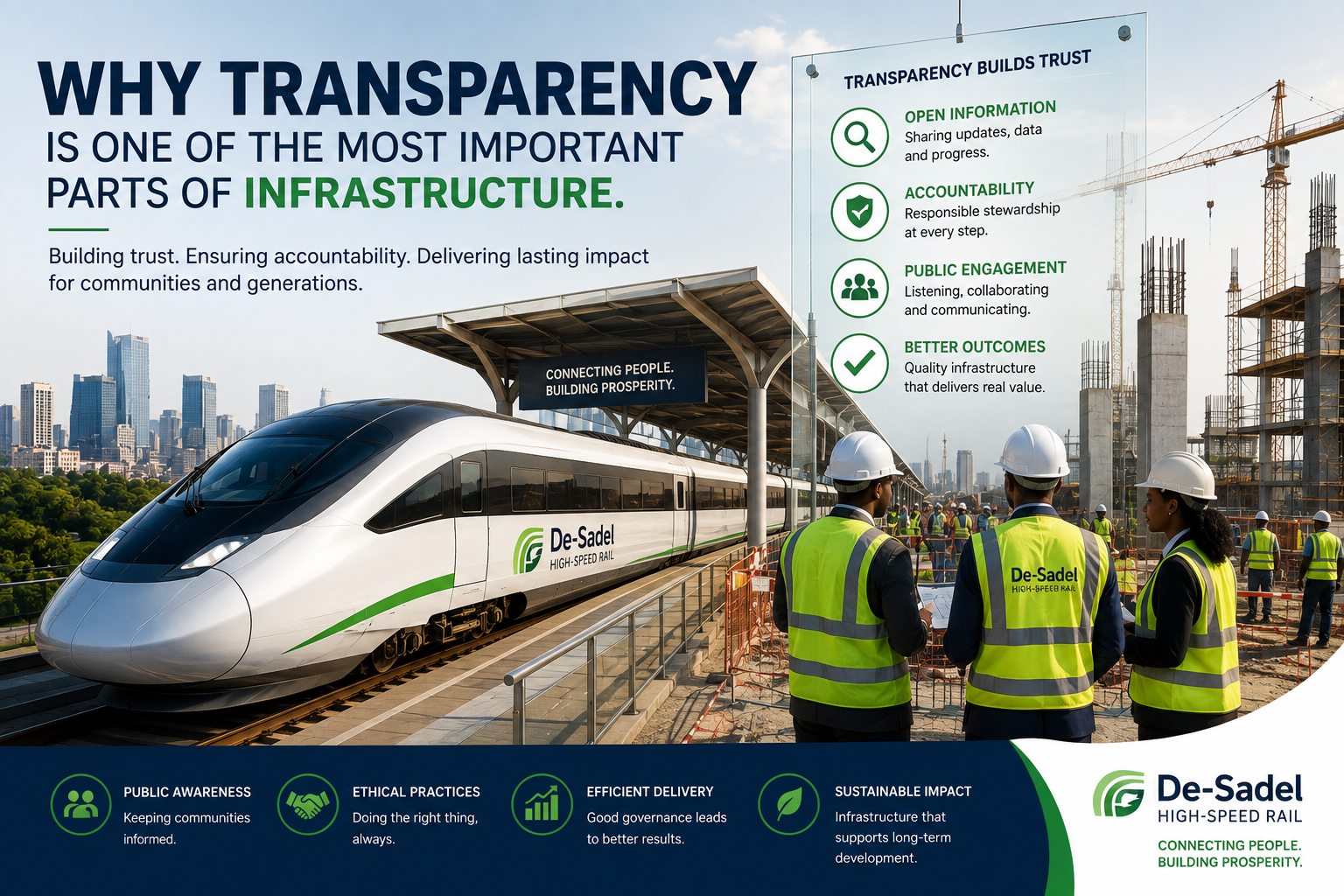
That is why the De-Sadel Media Unit is committed to providing timely, accurate, and valuable information on the progress of the High-Speed Rail project because transparency and public understanding are essential components of major infrastructure development.
By consistently sharing updates, explaining key project milestones, and providing educational content about the processes behind large-scale infrastructure delivery, the Media Unit helps stakeholders, communities, and the wider public stay informed about the project’s journey.
This commitment reflects De-Sadel’s belief that informed audiences are better positioned to understand how complex infrastructure projects evolve from planning to implementation, fostering greater awareness, confidence, and engagement throughout the project’s development.
Why Do Infrastructure Updates Matter?
When people do not have access to reliable information, gaps are quickly filled by assumptions, speculation, and misinformation.
A major infrastructure project can generate questions from the moment it is announced:
- What is the project?
- How much will it cost?
- Where will it pass?
- What stage is it currently at?
- Who is financing it?
- Who is responsible for delivering it?
- What benefits will it bring?
- When will construction begin?
- What approvals are required?
- How will host communities be affected?
Providing clear and timely answers helps stakeholders understand where a project stands and what needs to happen next.
For the De-Sadel High-Speed Rail Project, consistent infrastructure communication can help the public distinguish between what has been proposed, what is being assessed, what has received approval, and what is already under development.
That distinction is critical.
A project can be ambitious while still moving through different stages of planning, assessment, approvals, financing, procurement, and execution. Communicating those stages clearly helps create realistic expectations.
Transparency Reduces Misinformation
Large infrastructure projects naturally attract public interest. They also attract misinformation when information is limited or unclear.
When stakeholders have access to credible project updates, there is less room for speculation to dominate the conversation.
For a project as significant as the proposed De-Sadel High-Speed Rail, communication should consistently explain developments in simple terms whether that involves technical assessments, government approvals, financing arrangements, project timelines, routes, partnerships, or implementation milestones.
This does not mean every technical document needs to be communicated in complex language.
It means that important information should be translated into information people can understand.
That is the essence of effective public infrastructure communication.
Transparency Strengthens Stakeholder Confidence
Infrastructure projects depend on confidence.
Investors need confidence that the project has a clear framework and that relevant processes are being followed.
Government institutions need confidence that proposed infrastructure aligns with national development objectives, regulatory requirements, and public interest.
Host communities need confidence that they will be properly informed and considered throughout the project lifecycle.
The media need access to accurate information so they can report responsibly.
And the public needs to understand how a major project could affect their communities, economy, mobility, and future opportunities.
Transparent communication creates a common information environment where these different stakeholders can make better-informed decisions.
The Role of the Federal Government
Transparency is not solely the responsibility of the project developer or project owner. The government has an equally important role to play.
For major infrastructure projects, speedy and coordinated government approvals can be critical to maintaining momentum.
A project may require multiple regulatory reviews, technical assessments, environmental considerations, land-related processes, and approvals from relevant government agencies before different stages of implementation can proceed.
Clear communication between the project team and government institutions can help identify what is required, where decisions are pending, and what actions are necessary to move the project forward.
This is where project governance Nigeria becomes particularly important.
Good governance is not simply about approving projects. It is about creating a transparent process through which projects can be assessed, approved, monitored, and implemented efficiently.
For the De-Sadel Consortium and the Federal Government, maintaining clear channels of communication throughout this process can help reduce unnecessary uncertainty and ensure that legitimate approvals and decisions are handled as efficiently as possible.
Speed and transparency should not be viewed as opposites. A transparent process can actually support faster decision-making because stakeholders understand what is required, who is responsible, and where a project stands.
Host Communities Need a Voice
Infrastructure ultimately exists within communities.
A railway corridor may pass through numerous states, cities, towns, and communities. People living along the proposed route therefore have a legitimate interest in understanding how the project could affect them.
Effective stakeholder engagement in Nigeria should provide communities with information about issues that matter to them, including proposed routes, economic opportunities, environmental considerations, construction activities, employment possibilities, and other relevant impacts.
But communication should not be a one-way process.
Communities should also have opportunities to ask questions, express concerns, and provide feedback.
When people feel heard and adequately informed, it becomes easier to build the social trust required for large infrastructure projects.
Investors Need Clarity
Infrastructure requires significant capital, and investors need reliable information to evaluate opportunities and risks.
For potential investors and financing partners, transparency can demonstrate that a project is being approached systematically.
Clear communication around project development, governance structures, partnerships, technical assessments, approvals, financing arrangements, and implementation milestones can help investors better understand the project’s trajectory.
For an ambitious project such as the proposed De-Sadel High-Speed Rail, building investor confidence requires more than presenting the vision. It requires demonstrating how the vision is being translated into a structured and accountable project-development process.
The Media Has an Important Role
The media serves as a bridge between infrastructure projects and the public.
Journalists need access to accurate information to explain complex developments to their audiences. Without reliable information, reporting can easily become dependent on speculation, incomplete data, or unverified claims.
This is why infrastructure communication should include regular, accessible updates that give the media the facts they need to report accurately.
For project stakeholders, this also means being willing to address difficult questions.
Transparency is not only about communicating good news.
It is also about explaining delays, challenges, changes, approvals, and outstanding issues when they occur.
That is how long-term credibility is built.
Transparency Builds Accountability
A project that communicates its milestones creates a record against which progress can be understood.
If stakeholders know what stage a project has reached, they can better understand whether subsequent developments are occurring as expected.
This strengthens infrastructure accountability.
Accountability does not mean every project must progress without challenges. Large infrastructure projects inevitably encounter technical, financial, regulatory, environmental, and logistical complexities.
What matters is how those challenges are managed and communicated.
A transparent project can say:
This is where we are.
This is what has been achieved.
This is what remains.
This is what is being done next.
That level of clarity creates credibility.
Transparency Is a Shared Responsibility
For the De-Sadel High-Speed Rail Project, successful communication should therefore involve more than the project team.
It requires collaboration between:
- De-Sadel Consortium and project stakeholders
- Federal and state government institutions
- Investors and financing partners
- Host communities
- Regulatory agencies
- The media
- The Nigerian public
Each stakeholder has a different role, but they all benefit from access to accurate and timely information.
The objective is not simply to generate positive publicity.
The objective is to build understanding and trust around the infrastructure development process.
Building Trust Around Nigeria’s Infrastructure Future
Nigeria needs infrastructure that can support economic growth, improve connectivity, create opportunities, and strengthen the country’s competitiveness.
But infrastructure of this magnitude requires more than engineering excellence.
It requires trust.
And trust is built over time through consistent action, responsible governance, stakeholder engagement, accountability, and clear communication.
For the proposed De-Sadel High-Speed Rail Project, transparency can help stakeholders understand not only where the project wants to go, but also where it currently stands and what needs to happen to get there.
When government institutions communicate effectively with project stakeholders, approvals can be better coordinated. When project teams communicate with communities, concerns can be addressed earlier. When investors receive credible information, confidence can grow. When journalists have access to facts, misinformation can be challenged. And when the public understands the process, trust becomes easier to build.
Communication is not separate from infrastructure delivery. It is part of good infrastructure delivery.